A hawk flew up from a pine tree as we drove down I5 in Oregon last week and I suddenly remembered another bird, another trip. No matter where I travel, my favorite past time is looking for wild life. One of my best memories of visiting the Grand Canyon this week is seeing a family of deer -- a buck, doe and two fawns. What I remember most about visiting Paris was being awakened by the rich song of a robin. I lay under my thin blanket in a business hotel hear the Eiffel Tower, something like a Holiday Inn the review said. The room was tiny and spare by American standards -- not at all like a Holiday Inn, I thought, but certainly adequate.
It was May, and while the grass was green, this most romantic place had not yet embraced the warm colors of summer flowers. I rose and pulled back the curtain to see if I could see him, but the wet gray street was empty. These Parisians led a civilized life. At six a.m., it was just me and the robin. I was surprised to hear the sound that I counted on every year to let me know I'd survived the winter. Of course, I knew there were European Robins, but nonetheless, it seemed a rare moment to hear this fellow traveler. I could imagine him in the top of a leafless tree, head thrown back, mouth wide open, sounding out with all his heart. We'd come to Paris for history and art. He'd come for nothing but Love.
I did not see him, or even hear him again after that morning. Perhaps he flew on; perhaps he found his soul mate that very day. We enjoyed the sights and sounds of Paris, which was just what we'd expected. We got saturated with art and history at The Louvre, ducked under bridges on a Seine boat ride, sat on the grass beneath the Eiffel Tower, climbed up the Arche de Triumphe and became accustomed to being corrected when we tried to speak French.
It was May 2001, before the planes, before the war, before Freedom Fries, left me wondering just how welcome I am in the world. It is my ego that gives me these misgivings, of course. I am not so important that I would even be noticed when visiting most places. And in my heart I believe that when it comes down to it, I'm as welcome as the robin when I travel in the name of Love.
Monday, December 24, 2007

Sunday, October 21, 2007
Last Waltz

Last week, I made the long trip back to Saskatchewan, Canada, where I visited my Mom who's in a nursing home there, my brother, his wife and my neice. It has been nearly 50 years since I lived there, but something about just breathing the air takes me back to my childhood, and I am reminded that in my family, we didn’t tell stories, but we did sing. And there were times in January when word of an upcoming dance cracked the hard glass of winter in our little community. It was a “do-it-ourselves” event. Someone would wake up the furnace in a hibernating hall, and sprinkle green wax across its pale wooden floor, and someone else brought immigrant fiddles out of the closet and grandpa’s guitar from under the bed, and our Moms and Grandma’s baked bread, pies and chocolate cake.
In the crisp twilight of a Saturday night, everyone got there however they could. Some came in dust-creaky cars with their windows wide open to dilute fumes pouring from exhausted mufflers; some came in horse-snorting sleighs called ‘cutters’ that sailed between fence posts on a carpet of snowdrifts; and we felt the magic of being quilt-bundled kids perched high on a John Deere tractor fender, feeling big rubber burn a pathway through a Milky Way wilderness.
It was freezing cold, but worth it, to have a chance to smile at each other across a lantern-lit room, breathing sweet dust stirred up into sweet-shuffle dreams of romance lost and found, in a schottische, a two-step, a square dance or two, called out to a choir of swish-sliding shoes.
By ten, they’d be sprawled out tired, politely waiting on straight wooden benches around the wall, while young girls like me, with shy glances and shining hair, waltzed platters of white bread sandwiches all around the room, offering up the mashed up egg? the bologna with butter? the ham of the devil? And then we’d slide giggling back to the kitchen to lead a procession of porcelain mugs, followed by men hoisting blue spotted pots of smoky boiled coffee, calloused hands gripping hot wire handles with greasy potholders. They threw back their heads and laughed.
Later, while they were all rising an eye-blinding polka, we’d sneak out back to catch glimpses of teenagers drinking in cars, and to stand silently breathing in miles of uncountable stars. Then, we all laughed at once and ran shivering back to join in the singing of one last waltz, “Good Night, Sweetheart, Good Night.”
Sunday, October 7, 2007
Time Travelers

Sometimes I felt like we are time travelers. My earliest memories are so different from the way I live now, and they even come from a different century. I suppose every generation feels the same way, but it’s still hard to believe one family could have gone from horse-drawn sleighs to helicopters.
The long road forward has included all the pain and uncertainty it takes to grow up, but we can go back easily. Imagine we are driving down a dark summer road. Warm air rushes all of our memories in through open car windows; we hear, feel and smell them swirling around in the car. Many things flash by for an instant in the headlights, but on this journey, we only stop at bright spots – places that shine like welcoming yard lights at the ends of driveways.
We turn and drive up to the yard, climb out of the car, and stay as long as we want. We are welcome, no matter how long our journey.
The Art of Giving

Every year, I make pot holders to sell at our company United Way fundraiser. This simple act reminds me that I don’t have to do something extraordinary in order to do ‘good.’ It’s better to leave my ego behind and use my talents in simple ways.’
Thursday, August 30, 2007
We Are the Stories We Tell
I heard on a podcast this week that a person is nothing more, or less, than their ‘story.’ We ARE the stories that we tell. I love the way this idea brings what’s really important into focus. When I tell my story, I don’t talk about my job, my education or my possessions -- those are boring details. I talk about what I think and believe, my hopes and dreams, my sweetheart Walter, my daughter, her husband and pets, my Mom, Aunt and brothers, the history of my family, friends, and people I’ve met, what I’m reading, silly little adventures in my life, and my sweet little dog, Roxy. I recall moments of pleasure and sadness, grandeur and absurdity. I recollect the times I faced enlightenment when the truth was so hard to bear. I laugh out my pain and weaknesses, foibles and failures. I tell these stories because I love to hear others’ stories about the same things. A story given for a story received is a reassuring echo that connects me to the human family. The well told tale celebrates a love of humanity. Of all the clutter that fills my days, stories are the raindrops of joy that guide my little life-boat in the sparkling river of life.
Sunday, August 26, 2007
Dream Babies
Dream Babies are the retro-style toys I make. I can't explain why I've become so attracted to making art toys. Maybe it's because I've realized the importance of play to a happy life.
Monday, August 20, 2007
The Edge of Somewhere

For the past five days, I’ve been in the high Arctic, about a hundred miles south of the point where the furthest north rocky shore in Alaska gently touches the Beaufort Sea. I haven’t been up here for years and coming back, I find the place both remarkably the same and noticeably different.
The North Slope of Alaska is just that -- a huge plateau that begins at the Brooks Range and flows north for a hundred and fifty miles to a shallow icy sea. There’s a strip of land about 40 miles wide right along the ocean that it is really flat. Flat like Wisconsin without farms. But once you’ve drive an hour south, tundra covered hills roll out to the east and eventually these hills evolve into the stark rocks grey Brooks Range. There are trees here, a biologist showed me once, but they are short trees – two or three inches tall after hundreds of years, and at this time of year the groundcover of lichen, tiny trees and blueberry plants is like a rippling multi-color chenille blanket that stretches for miles over huge sloping swirls of land. The grandest superlatives can not define how huge the landscape seems when it is uncluttered with human artifacts. There is one narrow, gravel, winding, difficult road. There are no grain fields, cattle, power poles, gardens, clotheslines, children, or barking dogs. There is just a grand mostly-empty landscape, and clouds that hang so low the sense of perspective is pronounced as we drive into a receeding wedge of ground and sky. The land feels eternal. It is easy to look out into the misty distance and imagine herds of dinosaurs have just passed and are feeding just out of sight.
The big difference I notice after being gone is that there are more people here now. Back in the ‘old days,’ the road was reserved for long haul and other work trucks, and the only people I saw were like me, here for a week or two at a time to work. We weren't the first people here, of course, but we lived and work in concentrated small areas, restricted to them by rigid rules. Now there are brave and adventurous motorcycle riders with backpacks, hunters in campers and tourists staring at us from big white Princess busses. The other noticeable difference is that I see a lot less wildlife. I do see two loons, a few brown geese, gulls, a young brown eagle and a jaeger. Two ground squirrels run across the road, and we see a lone muskox on the bank of the Sagavirnoktok River. One friend tells me he saw a black wolf by Slope Mountain yesterday; another that there was a caribou last week.
I suppose this count is remarkable in comparison with most of the world. But I remember the days before the casual travellers came. Twenty years ago, there were huge white owls, wolves, falcons, foxes, grizzly bears, moose and hundreds of caribou right by the road. The herds of caribou are actually increasing in size, the biologists say, but it seems they’ve moved back from even this trickle of human contact. I’m told you can still see them in the distance sometimes, on the back side of a hill, grazing or moving in a fluid wave. Twenty years ago, they didn’t fear us because we were just trucks that drove by without stopping. Since then, generations of caribou have learned to stay out of sight of this ribbon of dust.
It’s a normal evolution I guess. The first wave of people are explorers, and they see the wonders of a new place. And they tell their friends, who follow in their tracks to the Last Frontier, the End of the World, the Edge of Nowhere. I understand these names, but I also realize that by the time it’s called that, a location is no longer what’s inferred. This is an edge beyond the reach of human comfort, but it is Somewhere – the edge of somewhere, to be sure, but somewhere nontheless. Nowhere ends when the casual traveller arrives. Nowhere ends when the abundance of other wildlife recedes.
Our windshield is tracked with gold streaks of mud. I’m watching the miles of green, gold lichen and red sail by. So beautiful, it seems wrong to call this “less.” My thoughts are not intended to blame, or to express shame, or support any political position. I accept human nature. It is what it is. I just feel a slight pinch of poignancy, looking out over the amazing curve of a faraway hill. I think of the dinosaurs, the caribou, and all creatures that have passed in this eternal migration. The surge of humans is coming into view; we’ll pass, and when our moment is over, some other being will emerge on the horizon, starry eyed to see such wonders.
Subscribe to:
Posts (Atom)
Serena from Sioux City
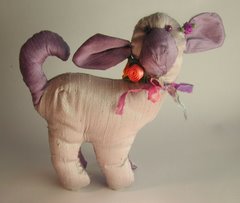
Flying Wow-Wows are handsewn from dupioni silk while I fly around the country for work and to be with family